
🎯 THE OBJECTIVE
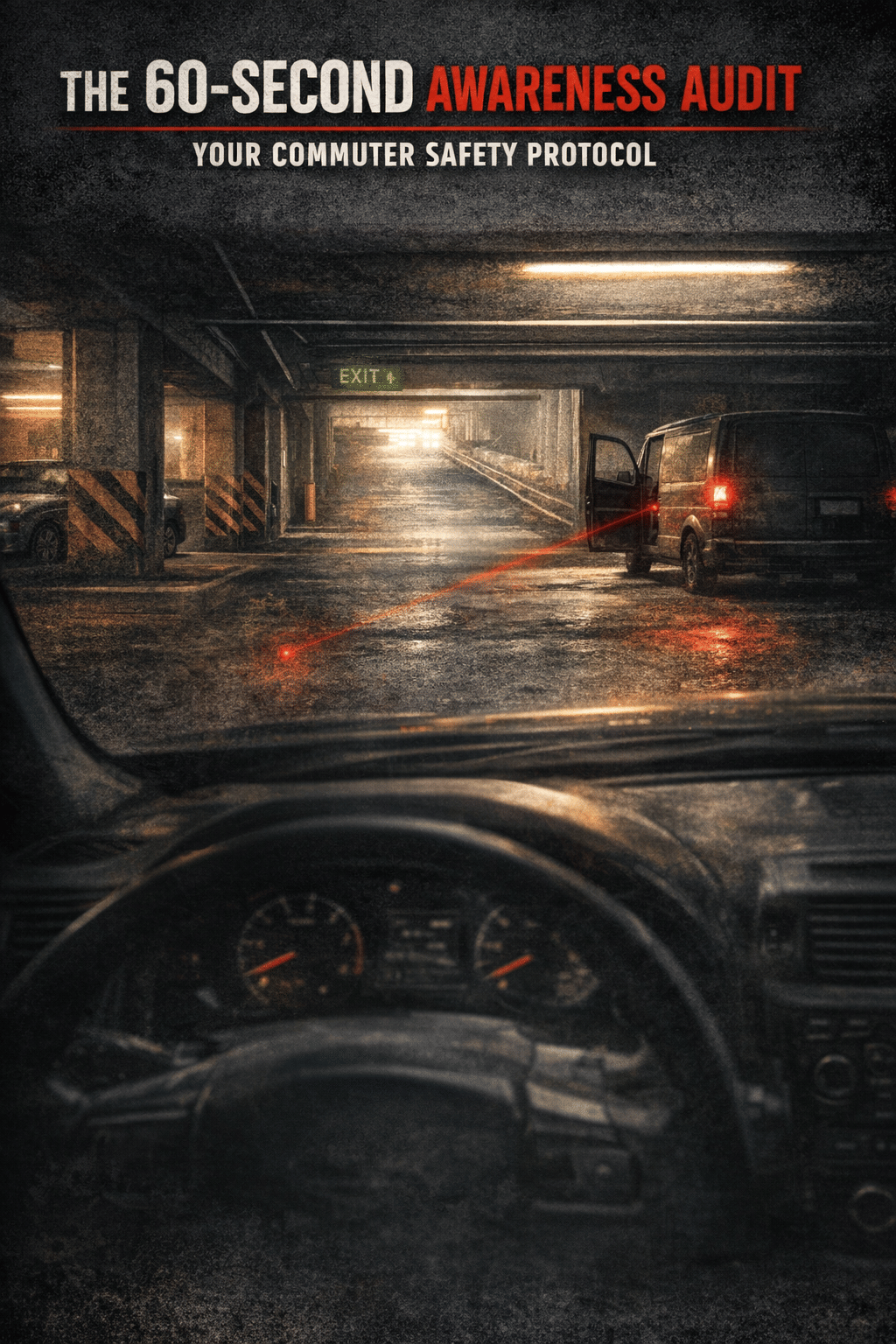
Navigate transitional spaces such as parking garages, office lots, and gas stations with calm, calculated confidence.
Most people walk into a parking lot, a restaurant, or a store entrance and lose the most important seconds of that environment without even realizing it. That is where they miss exits, overlook what does not fit, and give away options before anything even happens.
In professional protection work, the concern is not just the destination. It is the transition. The moment you leave the relative security of your office, your home, or a building and begin moving toward your vehicle, you enter what Grey Matter Ops calls the Grey Zone. In this space, you are mobile, often distracted, and moving between two points of relative safety.
For criminals, these moments can represent opportunity. For those trained in the Red Dot Mindset™, they represent a moment to slow down, observe, and regain control of their attention.
🧠 THE INTELLIGENCE: Why the "Grey Zone" Matters
Opportunistic offenders tend to look for the same basic conditions: low resistance, limited visibility, and distracted targets.
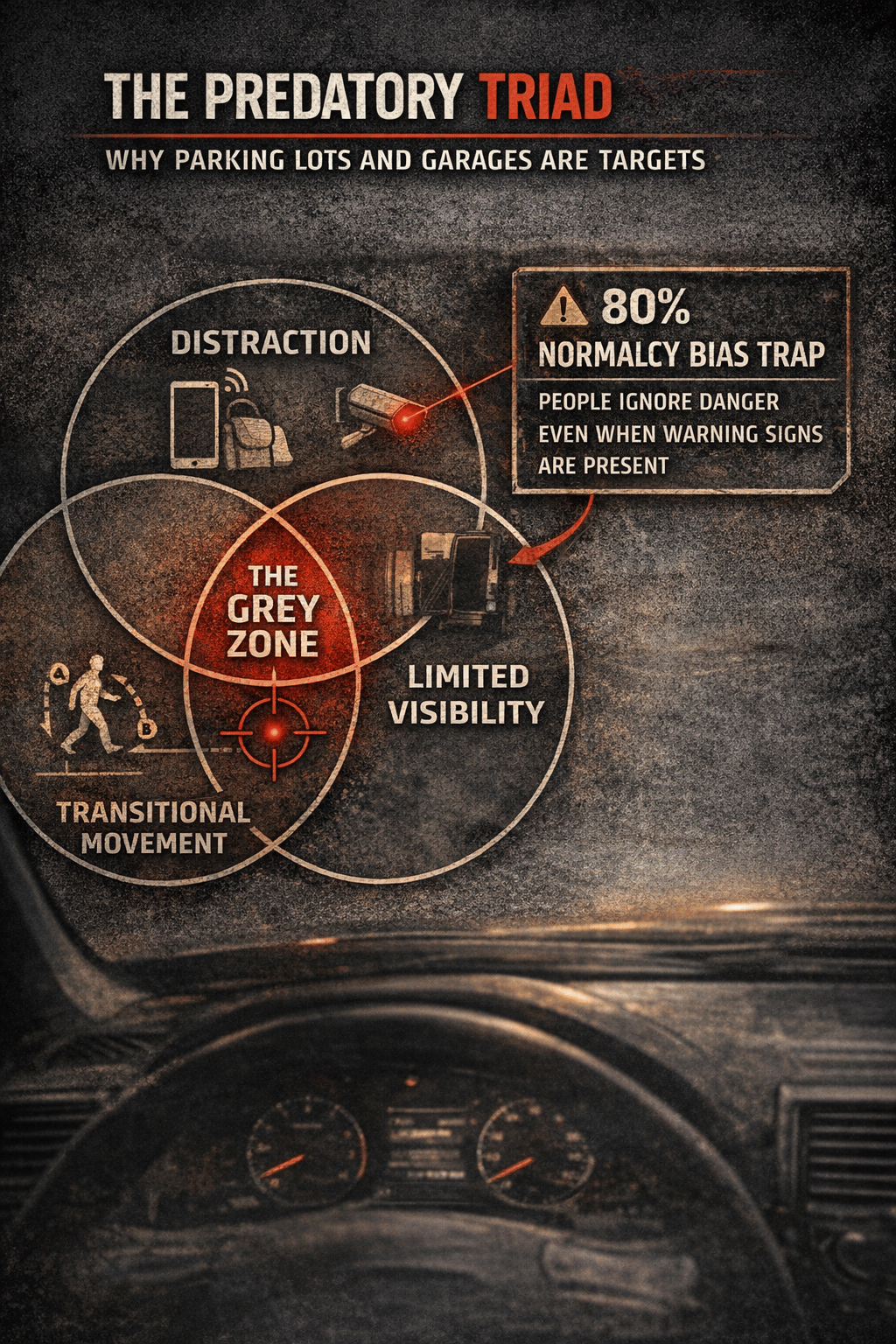
Parking lots and garages often provide exactly that. They combine three conditions that make transitional spaces harder to read and easier to exploit:
Distraction — phones, bags, fatigue, divided attention
Limited visibility — pillars, shadows, blind spots, larger vehicles
Transitional movement — people moving from one point to another without settling in
Most people also fall into normalcy bias. That is the internal voice that says:
I have walked to this car a thousand times. Nothing happened then, so nothing will happen today.
That mindset delays action. It causes people to dismiss small warning signs, hesitate when something feels off, and stay mentally behind the situation.
The Red Dot correction is simple: do not assume danger, but do anticipate possibility.
Pilots do not start engines until the pre flight check is complete. The Awareness Audit works the same way. It is your pre movement check before entering a transitional space.
The Habit That Wrecks Awareness Fastest
If there is one habit that destroys situational awareness faster than almost anything else, it is this: using your phone while moving through a transition space.
Walking to your car. Entering a store. Leaving a restaurant. Crossing a parking lot. These are not the moments to disappear into a screen.
Your phone narrows attention, slows processing, and steals the seconds that often matter most. There is a time to check messages. The middle of a parking lot is not it.
If you want to improve awareness immediately, start there. Put the phone away until you are where you need to be.
That one change will improve how much you notice and how early you notice it.
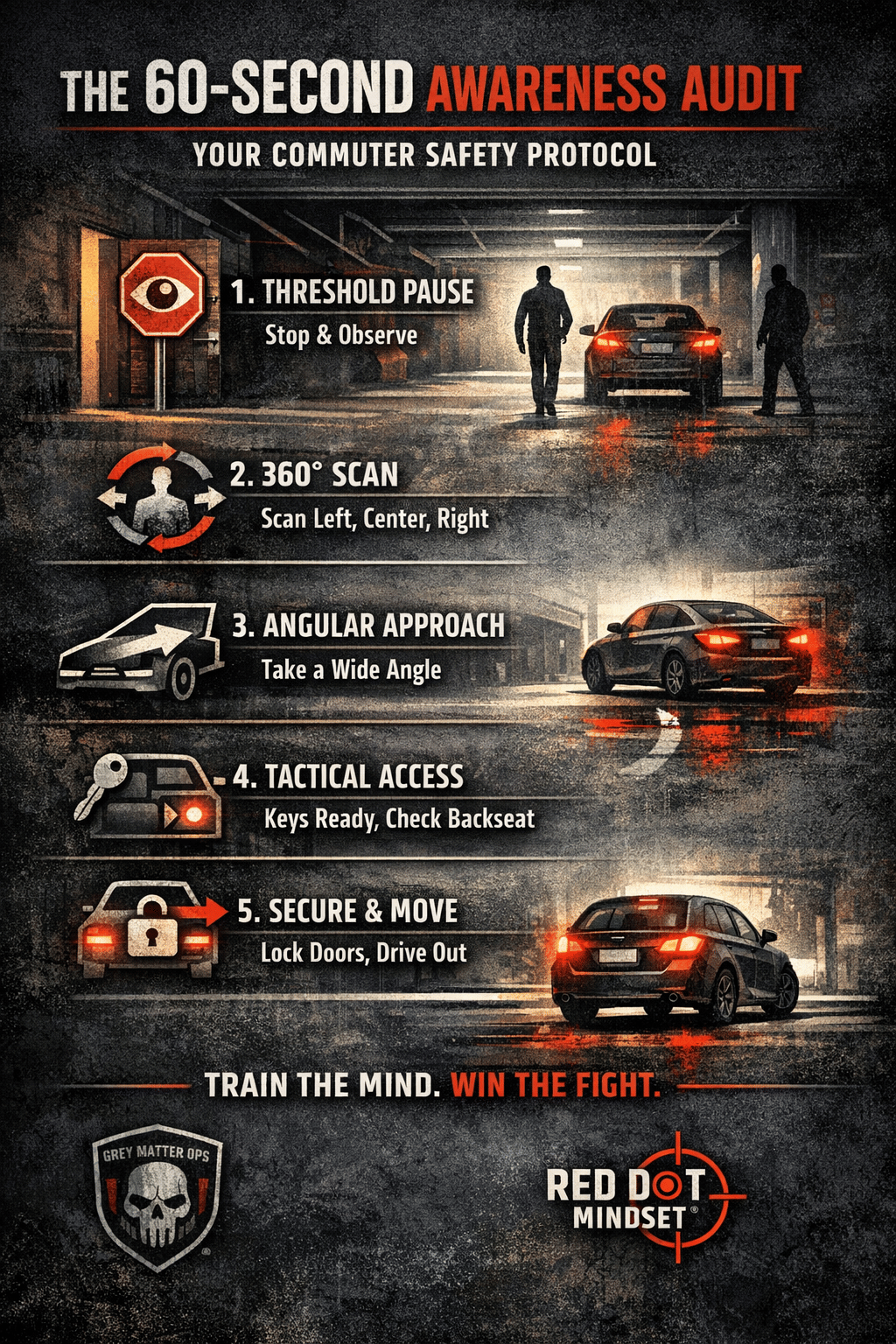
🔧 THE DRILL: The 60-Second Awareness Audit
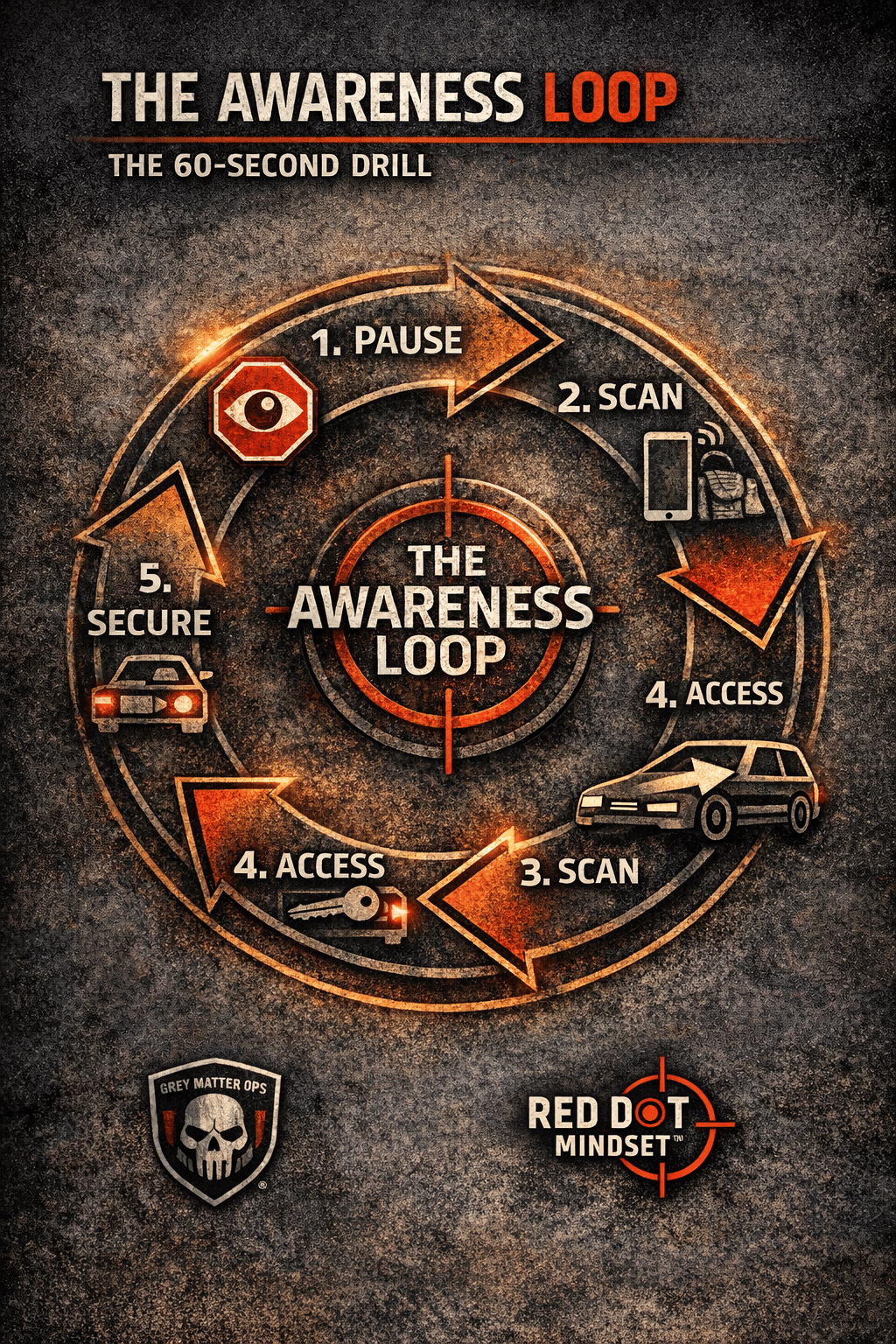
This protocol takes about sixty seconds. It is not about moving faster. It is about moving more deliberately.
Give yourself thirty seconds in almost any environment and you can usually identify three things quickly:
What is normal here
What is off
Where you would move if something changed
That is not paranoia. It is a system.
1. The Threshold Pause
Before exiting the building, pause.
Do not burst through the door while looking at your phone or mentally jumping ahead to the next task.
Awareness does not break down randomly. It often breaks down at the threshold. Any time you enter a building, leave a building, or move from one space into another, there is a brief moment where people slow down, hesitate, bunch up, or drift mentally. That is where awareness tends to fall apart.
Look through the glass if you can. Check lighting, weather, activity, and movement. Once outside, do not stop in the doorway. Move through it. Step off the line. Get your bearings.
Goal: Shift your brain from task mode to awareness mode.
2. The 360 Scan
As you step outside, resist the instinct to walk directly to your car.
Conduct a simple scan: left, center, right. Notice where people are flowing and where they are bunching up. Then ask yourself one question:
If this space changed fast, where would I move?
Look for what does not fit:
A vehicle parked unusually close to your driver side
A person sitting in a running vehicle with no clear purpose
Someone matching your pace or subtly affecting your movement
Most people only remember the door they came through. A trained mind looks for one more option. Not because it expects trouble every time, but because options reduce hesitation. The sooner you identify an alternate path or exit, the less likely you are to freeze or get funneled into a bad position.
Goal: Identify concerns before you move within someone else’s reach.
3. The Angular Approach
Avoid the straight line path.
Approach your vehicle at a slight angle when possible. This gives you a better view of the area around it and helps clear blind spots created by pillars, vans, trucks, or neighboring cars before you close distance.
As you move toward your vehicle, keep it simple:
Look out first — what is happening along your path to the car
Look in close — what is happening around the vehicle itself
That alone can buy you a few extra seconds, and those seconds matter.
You are not scanning for threats everywhere. You are noticing what breaks the pattern:
A person too close to your vehicle
A car moving oddly through the lane
Someone positioned between vehicles without an obvious reason
Goal: Maximize visibility and reduce surprise.
4. Tactical Access
Once you have read the space, reduce your exposure at the vehicle itself.
Your keys should already be in your hand before you exit the building. Do not stand at the door or beside the vehicle searching through a purse, bag, or pocket.
As you unlock the vehicle, give the interior a quick visual check, including the backseat.
Goal: Minimize stationary time in the Grey Zone.
5. Secure and Move
Once inside, lock the doors immediately.
Avoid admin time. Do not sit there checking messages, adjusting settings, or organizing belongings while stationary in a vulnerable space.
Start the engine and begin moving.
The vehicle is a mobility tool. Use it like one.
Goal: Close the window of opportunity quickly.
The Debrief
Preparedness is often mistaken for paranoia, but there is a clear difference.
Paranoia is driven by fear. Preparedness is driven by awareness.
Sometimes nothing obvious jumps out at you, and something still feels off. That matters.
Your brain is constantly picking up information before your conscious mind can fully explain it. Tone. Timing. Distance. Movement. The way something fits, or does not fit. That uneasy feeling is often your mind recognizing a pattern before you can name it.
That does not mean panic. It means pause, reassess, and give yourself permission to create distance.
You do not owe a suspicious situation your time just because you cannot explain it perfectly. If something feels wrong, you do not need to stand there and debate it. You can leave, reposition, slow down, or reset the situation on your terms.
That is not paranoia. That is your awareness doing its job.
When you run the 60 Second Awareness Audit, you are not telling yourself the world is dangerous. You are acknowledging that your safety is worth sixty seconds of deliberate attention.
The goal is not to move through life tense. The goal is to move through it with more awareness, more time, and more options.
The more often you practice the audit, the more natural it becomes.
Small habits practiced daily build the instincts that matter when seconds count.
Final Takeaway
The next time you walk into a parking lot, step out of an office, or cross a gas station lot, do one thing differently:
Put the phone away and run the audit on purpose.
That single minute can change how much you notice, how early you notice it, and how many options you still have if something shifts.
Train the Mind. Win the Fight.
Awareness is Armor.
For more tactical insights, follow Red Dot Mindset.
Remember: Awareness is Armour. For more tactical insights, subscribe to Red Dot Mindset.