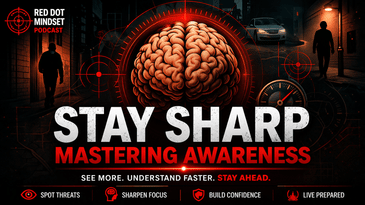

Most people move through their day seeing everything and processing almost nothing.
In this episode, we break situational awareness down into three practical steps: notice what is happening, make sense of it, and anticipate what may come next. This is not fear-based living. It is a disciplined way of moving through the world with more clarity, confidence, and control.
Inside this episode:
The three-part model of situational awareness
Why denial and distraction cause people to miss danger
How your brain filters information and what to do about it
Simple drills like Kim’s Game and the Eyewitness Test
The OODA Loop and decision-making under stress
Everyday habits that help you stay calm, alert, and harder to catch off guard
Whether you are commuting, traveling, or simply moving through daily life, the goal is the same: become harder to surprise and quicker to understand what is unfolding around you.
If you are ready to sharpen your awareness without living in fear, this is where that work begins.
🧠 Tactical Brief: Situational Awareness — The Awareness Advantage
Developed by: Mickey Middaugh — Founder, Grey Matter Ops™ | Tactical Mindset & Civilian Preparedness
Series: Red Dot Mindset™ Podcast Deep Dive
Mission Motto: Train the Mind. Win the Fight.™
🎯 Mission Objective
Decode situational awareness as both mindset and method by turning perception, comprehension, and projection into practical daily-readiness skills for civilians, protectors, and teams operating in dynamic environments.
🧩 Key Insights
The Three Phases of Awareness (Dr. Mica Endsley)
Perception — Actively observe your environment
Comprehension — Interpret what is happening in context
Projection — Anticipate what could happen next
Situational awareness is not passive observation. It is active engagement with the environment: see what is there, understand what it means, and recognize what may come next.
Filtering Reality
The brain automatically filters sensory input to prevent overload. Awareness means deliberately directing attention when the stakes are high.
⚔️ Threat Awareness and Denial
Denial blinds. The “it won’t happen to me” mindset causes people to dismiss warning signs that deserve attention. The episode uses the example of an energy executive in Manila who ignored his own intuition before being kidnapped.
📵 The Modern Threat: Distraction
Phones, headphones, and complacency pull attention away from the present moment and reduce early warning capacity. The episode points to a Mexican federal judge who was attacked while jogging with headphones on.
🧠 Skill Development
Kim’s Game — Short-term recall drill that sharpens observation
Eyewitness Test — Quick-look memory training for faces and details
Environmental Awareness — Know exits, routes, and likely danger areas before you need them
Peripheral Scanning — Expand your visual field to reduce tunnel vision
These drills align closely with the transcript’s emphasis on deliberate practice and active observation.
🚶 Everyday Defensive Habits
Keep one hand free
Trust your gut and disengage early
Walk with awareness and confidence
Scan before reaching for your phone
Sit where you can see entrances and movement
Stay alert at ATMs, gas pumps, parking lots, and while entering your vehicle
🟡 Cooper’s Color Codes
White — Unaware
Yellow — Relaxed alertness
Orange — Focused attention on a potential problem
Red — Active response to a threat
Black — Full crisis or confrontation
The transcript frames Condition Yellow as the practical civilian baseline: alert, calm, and not paranoid.
🔄 The OODA Loop (Observe, Orient, Decide, Act)
Developed by Col. John Boyd, the OODA Loop turns awareness into decision-making. The Orient phase is where situational awareness does its work: understanding context, recognizing patterns, and adapting before the threat acts.
🧰 Improvised Response
In a critical moment, everyday objects may create distance, distraction, or an escape opportunity. The key point is not fighting. It is recognizing options in the environment.
🧩 The Civilian Application
Perceive — Observe the environment using all available senses
Find Meaning — Connect the dots and recognize context
Project — Anticipate what may happen next and prepare your response
Calm, deliberate observation widens perception under stress.
🧭 Mindset Over Mechanics
Situational awareness is not paranoia. It is preparation.
You are not just watching life happen. You are learning to read the terrain before it shifts.
🪖 Tactical Takeaway
“Awareness is not about seeing more. It is about seeing what matters most.”
📘 Recommended Reinforcement
Dr. Mica Endsley — Situational Awareness Model
Col. Jeff Cooper — Color Code System
Col. John Boyd — OODA Loop
Gavin de Becker — The Gift of Fear
Awareness Is Armour™
Stay Grey. Stay Ready.