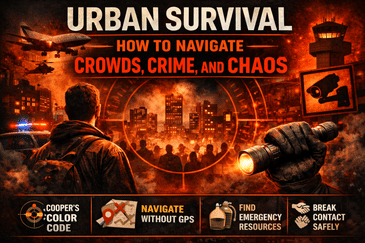

Urban environments create opportunity, but they also create friction: crowds, noise, distraction, anonymity, and total dependence on digital systems. Most people move through that environment half-checked out. This episode is about doing the opposite.
In this episode of Red Dot Mindset, we break down the practical realities of moving through modern cities with greater awareness, confidence, and control. This is not fantasy survivalism, and it is not fear-based thinking. It is a civilian-ready discussion on how to stay calm, read the environment, and make better decisions when conditions shift.
At the center of the conversation is situational awareness. We examine how Cooper’s Color Code applies to everyday urban life, why relaxed alertness should be your baseline, and how intuition often catches anomalies before your conscious mind can explain them. In a city full of noise, your ability to notice what is off, and act early, matters.
The GPS Trap: You will learn how to navigate dense urban spaces when technology fails or becomes a crutch. We cover the value of paper maps, landmarks, city grids, elevated vantage points, and the awareness habits that help you keep your bearings when power, signal, or normal systems break down.
You will also learn how to move through crowds with more control: how to read flow, why the edges often give you better visibility and mobility, how to avoid getting trapped in a surge, and what changes when you are moving with family or children. The goal is not paranoia. The goal is to stay hard to surprise.
The episode also addresses resourcefulness and profile management in the urban environment: water, shelter, communication plans, rally points, blending in, and building a practical get-home capability without advertising yourself. Low profile. Clear thinking. Deliberate movement.
Finally, we examine avoidance and break-contact principles if something feels wrong. That includes route planning, unpredictability, breaking line of sight, and the mindset needed to adapt under pressure. In the city, gear matters, but your greatest asset is still upstairs: how you observe, how you think, and how quickly you adjust.
In this episode, you will learn how to:
Apply Cooper’s Color Code to strengthen everyday urban awareness
Recognize red flags in changing environments and crowded spaces
Navigate more effectively when GPS, power, or communication systems fail
Identify practical urban resources for short-term resilience
Use break-contact and avoidance principles if something feels off
Build a calmer, more adaptive mindset under stress
We draw from trusted voices and proven frameworks, including Gavin de Becker, Jeff Cooper, Patrick Van Horne, Jason Riley, and Clint Emerson, while translating those principles into practical civilian application.
This is not about living in fear. It is about preparation, awareness, and moving through the world with greater clarity and control.
Train the Mind. Win the Fight.
Stay Grey. Stay Ready.™
Awareness Is Armour.™
Developed by: Mickey Middaugh — Founder, Grey Matter Ops™ | Tactical Mindset & Civilian Preparedness
Series: Red Dot Mindset™ Podcast Deep Dive
Mission Motto: Train the Mind. Win the Fight.
Urban Survival 101
Tactical Brief
🎯 Mission Objective
Practical urban survival principles rooted in mindset, awareness, and adaptability — not fear. Move with intent, read the environment, and navigate chaos with calm precision.
🏙️ Urban Terrain Awareness
Cities create opportunity, but they also concentrate risk. Crowds, noise, distraction, blind spots, and human unpredictability all increase friction.
Awareness is your first line of defense.
Complacency is the silent threat.
Condition Yellow is your operating baseline: relaxed alertness.
🧭 CONDITION YELLOW — THE URBAN BASELINE
Maintain steady awareness without slipping into paranoia.
Eyes up. Phone down.
Know exits, choke points, and likely escape routes.
Keep music low enough to stay responsive to changes around you.
Stay present without becoming tense.
⚙️ Cooper’s Color Code in Motion
Use the color code as a mental framework for shifting with context.
White: Unaware, distracted, vulnerable
Yellow: Relaxed, alert, present
Orange: Specific concern identified — evaluate and prepare
Red: Act decisively — move, escape, or engage as required
You do not live in Red. You train to move fluidly between states as the situation demands.
🧠 Intuition as Intelligence
Intuition is not magic. It is your mind detecting cues before your conscious brain fully explains them.
Listen to it.
Validate it through observation.
Act early before hesitation takes over.
🚶 Crowd Dynamics — Move with Purpose
Crowds can conceal danger, create confusion, or provide cover. Treat them like terrain.
Stay near the edges for visibility and maneuverability.
Watch the flow. Sudden surges, halts, or directional shifts can signal trouble.
In a panic, move diagonally across the flow, not directly against it.
Establish primary and secondary rally points when moving with family or a group.
🗺️ Navigation Without Tech
When digital systems fail, navigation becomes a skill again.
Carry a paper map and compact compass.
Use landmarks and skyline features as orientation anchors.
Understand your city’s grid and major routes.
Apply the 180° Rule: periodically look behind you so you can recognize the route in reverse if you need to backtrack.
Practice mental mapping and identify safe corridors, choke points, and alternate paths.
💧 Resource Priorities — Water, Shelter, Movement
Urban survival depends on practical improvisation and sound judgment.
Water: Boil, filter, or purify before use. Avoid untreated or questionable sources.
Shelter: Home is Plan A. If displaced, assess safety before entry: structure, exits, visibility, and access.
Movement: Use lit, populated routes when conditions allow. Break predictable patterns when conditions do not.
🕶️ The Grey Principle — Blend to Survive
Visibility often increases vulnerability.
Dress neutral and conceal valuables.
Keep defensive tools discreet.
Look like you belong in the environment you are in.
The baseline matters: what blends in at a business district may stand out in a park, transit stop, or neighborhood.
Move like you belong: calm, quiet, and controlled.
🎒 Urban Kit Essentials
24–72 Hour Get-Home Bag
Core
☐ Water
☐ Water purification tabs or filter
☐ Flashlight
☐ First aid kit
☐ Cash
☐ Paper map
☐ Compass
Support
☐ Multi-tool
☐ Hand-crank radio
☐ Spare battery or power bank
☐ Light cover garment
☐ Compact hygiene items
🧰 Crisis Framework — OODA Loop Applied
Observe → Orient → Decide → Act
Observe: What is happening?
Orient: What does it mean to me?
Decide: What is my best move?
Act: Do it now.
Speed beats hesitation.
🧍 Human Behavior & Self-Defense Layer
If awareness fails, defense begins.
Carry practical non-lethal tools such as pepper spray, a flashlight, or a personal alarm.
Use simple, proven tactics to create distance and escape.
De-escalate verbally when possible.
Disengage quickly when it is not.
📡 Communication & Contingency Planning
Do not wait until the crisis starts to build your plan.
Prearrange meeting points with family or team.
Know your analog options: two-way radios, mesh networks, handwritten notes.
Use short, clear communication under stress.
Establish simple code phrases for: I’m safe, Come get me, and Do not reply.
🧩 Urban Evasion & Exit Planning
If leaving the city becomes necessary, have options.
Know primary, secondary, and tertiary exit routes.
Use cover, angle changes, and natural breaks in the crowd.
Break contact through unpredictability and line-of-sight disruption.
Identify temporary hide sites for observation, recovery, and replanning.
🧘 The Mental Edge — Calm Under Chaos
Mindset still outruns gear.
Train composure through box breathing, visualization, and micro-drills.
Focus on the next right move.
Fear management is a survival multiplier.
Mindset is mobility.
📚 Sources Acknowledged
Gavin de Becker — The Gift of Fear
Jeff Cooper — Principles of Personal Defense
Dave Grossman — On Combat; On Killing
Jason Hanson — Spy Secrets That Can Save Your Life
Garand Thumb
Survival Dispatch
Urban Prepping Secrets
Corson Security Group
LifeSurvivalSkill.com
Train the Mind. Win the Fight.
Stay Grey. Stay Ready.™